The Heavy Burden of Unpredictable Power Bills
Let's be honest—opening your summer power bill feels like getting robbed in plain sight. I used to follow my family around the house, snapping off light switches and adjusting the thermostat, only to see my utility costs jump again at the end of the month. If you are tired of renting electricity and watching rates climb for no good reason, it is time to put your roof to work.
Picture this familiar scenario. You walk to your mailbox after a long day of work. You pull out a stack of envelopes, and right in the middle is that dreaded letter from your local utility company.
Your heart rate goes up just a little bit. You rip the envelope open, unfold the paper, and the number staring back at you instantly ruins your mood. You immediately start thinking about how much money you just lost.
Yet, despite all your careful efforts, the monthly bill keeps climbing higher and higher. It feels like a punishment just for trying to live comfortably in your own home.
You are essentially trapped in an endless cycle of renting electricity from massive power companies. They have complete control over the rates, and they raise their prices whenever they want. You have absolutely no choice but to pay whatever they demand.
This lack of control quietly drains your bank account and steals your peace of mind. But what if you could finally break free from this endless cycle of renting power?
What if your own roof could silently generate the energy you need, paying your power bills for you? That is the exact promise of home solar power. Let us look closely at how this amazing technology actually works, using simple terms anyone can understand.
What You Will Learn Today (Quick Summary):
- How your home takes direct sunlight and turns it into everyday AC power.
- The secret behind "Net Metering" and how it cuts your nighttime energy costs.
- Why simple things like tree shade and dirt can ruin your power production.
- The two massive traps you must avoid: old roofs and toxic solar leases.
Escaping the Utility Trap: How the Sun Becomes Your Power Plant
When most people look at a solar system on a neighbor's roof, they see a complicated mess of glass and wires. It looks like something that belongs on a space station, not a family home.
Because it looks so technical, many homeowners assume it is too complicated for them to understand. They get easily intimidated by aggressive salespeople tossing around terms like "kilowatts" and "photovoltaics."
However, the core concept behind generating your own power is wonderfully simple. You do not need an engineering degree to understand how your home can harness the sun.
Think of a residential solar setup as a personal, silent power plant that sits quietly above your head. It has no moving parts, makes no noise, and requires very little attention from you.
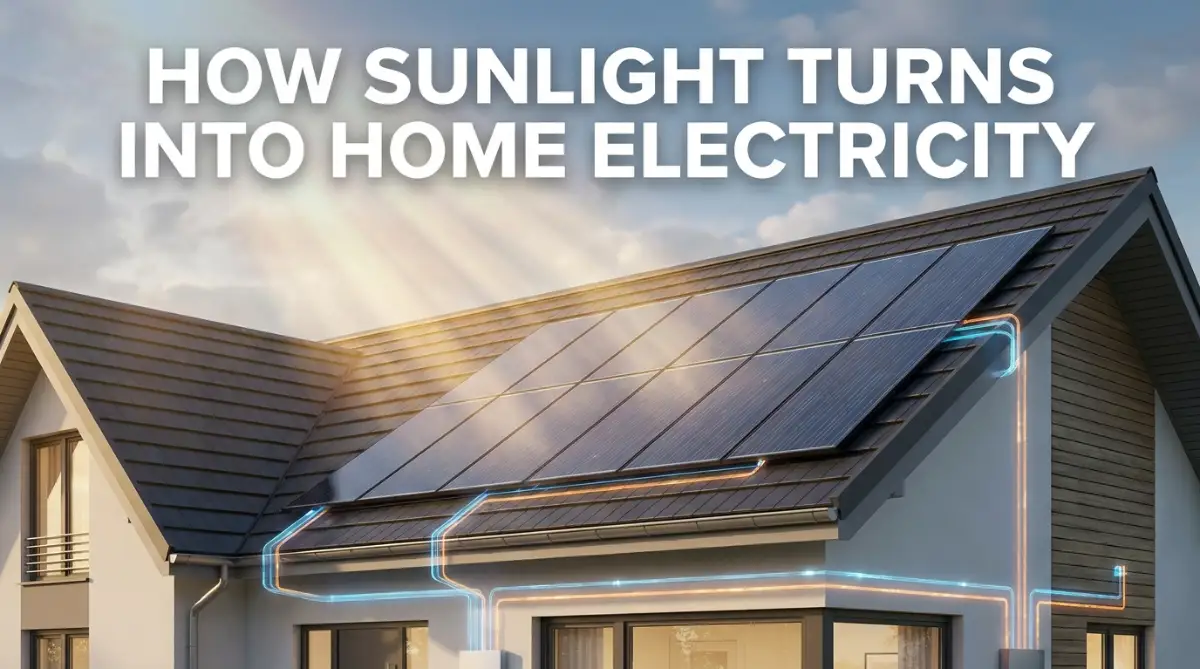
To help you feel completely confident about this technology, we are going to break down the entire journey of electricity. We will follow a single ray of sunlight from the moment it hits your roof to the moment it turns on your television.
The Silent Workers: Understanding Solar Panels
The journey begins with the panels themselves. These dark, sleek rectangles are the most visible part of any residential system.
Inside each panel are dozens of small squares called solar cells. These cells are made of silicon, which is the exact same material used to make computer chips.
When a ray of sunlight hits these silicon cells, something amazing happens. The light carries tiny particles of energy called photons. These photons strike the silicon and knock invisible electrons loose from their resting places.
Once these electrons are knocked loose, they start running around inside the panel. The panel is designed to force these moving electrons into a single, organized path.
This continuous flow of moving electrons is exactly what we call an electrical current. As long as the sun is shining, the panel acts like a steady water pump, pushing electricity down off your roof.
The Translator: Why You Need an Inverter
Now, we run into a small technical problem. The electricity coming straight off your roof is known as Direct Current, or DC power.
Your home appliances, your television, and your lighting system cannot use DC power. Your house is wired to run on Alternating Current, or AC power.
Imagine you are traveling to a foreign country. You have a wallet full of US Dollars, but the local shops only accept Euros. You cannot buy a cup of coffee until you find a currency exchange booth to swap your money.
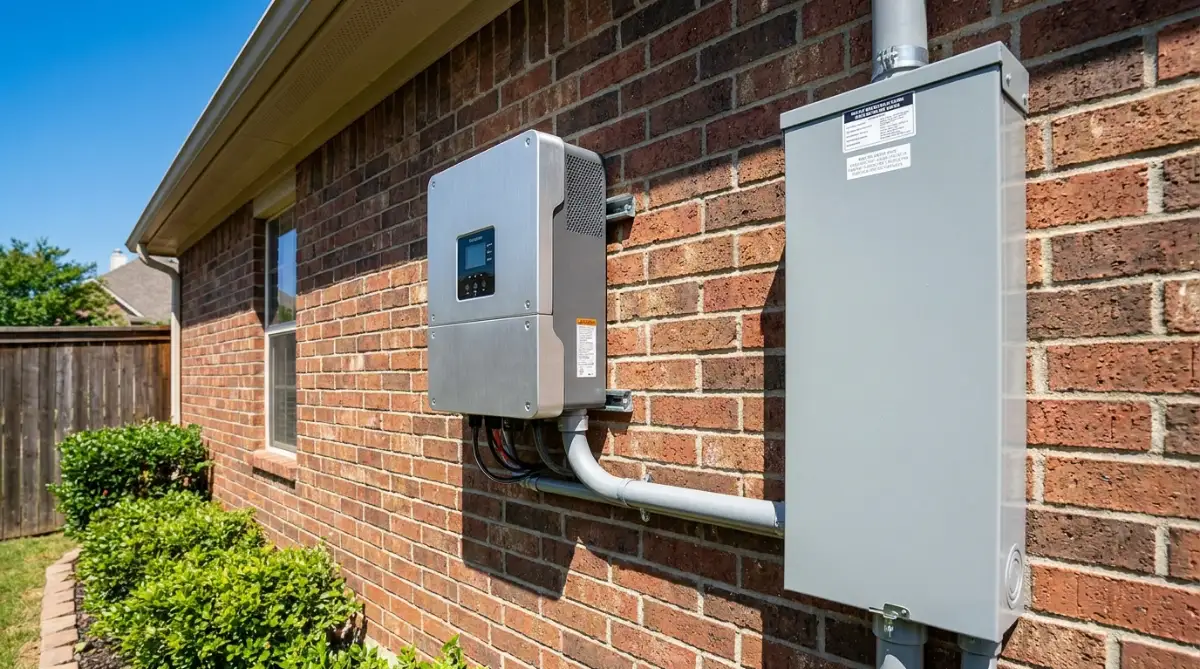
An inverter is the currency exchange booth for your home. It takes the raw, unusable DC power from your roof and translates it into the AC power your house demands.
This device is usually a small metal box mounted on the side of your house, right next to your main electrical panel. Without this smart little box, all the energy your roof collects would be completely useless.
Pro Tip:
Always ask your installer about the type of inverter they plan to use. Micro-inverters sit under each individual panel, meaning if one panel falls under a tree's shadow, the rest of your roof keeps working at full speed.
The Traffic Cop: Your Main Electrical Panel
Once the inverter translates the electricity, it sends that power directly into your home's main electrical panel. You probably know this as your breaker box.
This box acts like a highly efficient traffic cop. It looks at all the electricity coming from your roof and decides exactly where it needs to go right now.
If your refrigerator compressor suddenly kicks on, the traffic cop sends solar power directly to the kitchen. If you turn on your ceiling fan, the power is routed to your living room.
The best part is that this entire process happens in the blink of an eye, completely automatically. You do not have to flip any special switches or tell the system what to do.
Your home will naturally consume the free solar energy first, before it ever asks the utility company for extra power.
The Magic of Net Metering: Spinning the Meter Backward
If you are a visual learner, check out this short video that perfectly explains exactly how Net Metering works. Watch it quickly before reading on so you can see how spinning your meter backward turns into real savings for your family!
This brings us to the most exciting part of owning a residential system. What happens when your roof produces more power than you can actually use?
Imagine a beautiful, sunny afternoon. You are at work, the kids are at school, and the house is completely empty. Very few appliances are running, but your roof is working at maximum capacity.
Instead of letting that precious energy go to waste, your system sends it backward through your electric meter and pushes it out into the city's power grid.
When this happens, your utility company actually acts like a massive storage bank for you. They receive your extra electricity and give you a special credit on your account.
This policy is called Net Metering. In many areas, you can physically watch your electrical meter spin backward as you send power to the city.
Quick Look: Net Metering Vs. Buying a Battery
| Feature | Net Metering (Using the City Grid) | Home Battery Backup |
| :--- | :--- | :--- |
| Upfront Cost | $0 (Usually included with setup) | $8,000 - $12,000+ extra |
| Nighttime Power | Uses your daytime utility credits | Uses stored power from your battery |
| Blackout Protection | Fails if the city grid goes down | Keeps your lights on during outages |
| Best For | Most standard suburban homes | Areas with frequent, severe storms |
Myth vs Reality:
- Myth: You must buy huge, expensive batteries to store your extra daytime energy for nighttime use.
- Reality: Most homes do not need batteries at all. Through Net Metering, the city grid stores your excess power in the form of billing credits.
What Actually Happens When the Sun Goes Down?
A very common question beginners ask is, "Will my lights turn off when the sun sets?"
The answer is absolutely not. Your home remains permanently connected to the city power grid, even after you install panels.
When the sun goes down, your roof stops producing electricity. Without missing a single beat, your home automatically pulls the power it needs from the regular utility grid.
Real Talk: Do my lights stay on during a neighborhood blackout?
I get this question all the time. The short answer is: No, unless you have a battery backup. For safety reasons, standard grid-tied systems automatically shut down during a power outage so they do not send active electricity into the power lines while repair crews are working on them.
Remember those credits you earned during that sunny afternoon? You get to use them now. The power you draw from the city at night is offset by the excess power you gave them during the day.
If your system is sized correctly, your daytime credits will perfectly cancel out your nighttime usage. This brilliant balancing act is exactly how homeowners achieve a zero-dollar electricity bill.
Does the Weather Ruin Everything?
Another massive concern for beginners is bad weather. It is natural to worry that a few cloudy days will leave your family sitting in the dark.
It is true that thick clouds reduce the amount of sunlight hitting your roof. On a rainy day, your system might only produce thirty percent of its normal capacity.
However, panels are incredibly sensitive. They do not need direct, blinding sunlight to function. They can capture scattered light pushing through the clouds and still generate a meaningful amount of power.
Think about how you can still get a sunburn on a cloudy day at the beach. The sun's energy is still reaching the earth, and your panels are still catching it.
Furthermore, you are still connected to the grid. If a massive storm rolls in and your panels slow down, your home simply pulls whatever extra energy it needs from the utility company automatically.
Assessing Your Home's Natural Potential
Not every house is a perfect candidate for solar power. Before you get too excited, you need to understand how your physical environment impacts the system.
The direction your roof faces is incredibly important. If you live in the Northern Hemisphere, a roof facing straight south is the absolute gold mine for sunlight.
South-facing roofs catch the sun's rays for the longest part of the day. East and west-facing roofs are also good, though they produce slightly less overall energy.
However, if your only available roof space faces perfectly north, you might struggle to generate enough power to make the investment worthwhile.
The Silent Thief: Managing Roof Shade
Direction is important, but shade is the ultimate enemy of solar production. You must look at your property with a highly critical eye.
Do you have massive, old oak trees towering over your house? Is there a three-story apartment building next door that blocks the afternoon sun?
Even a small amount of shade can cause big problems. If a tree branch casts a dark shadow over just one or two panels, it can act like a bottleneck.
This bottleneck can slow down the entire system, much like a single car accident can slow down an entire highway of traffic.
Before calling an installer, stand in your yard at different times of the day. Watch how the shadows move across your roof from morning until evening.
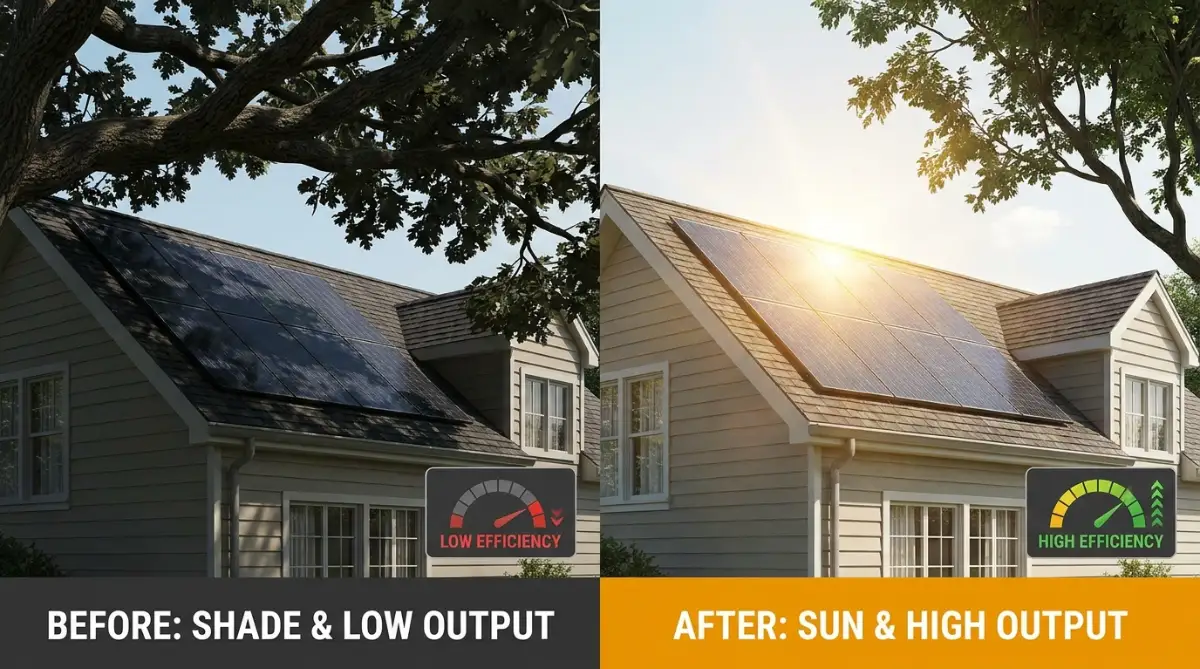
If your roof is heavily shaded all day long, you may need to consider trimming your trees before you even think about installing a system. Recognizing these physical limitations early will save you a lot of frustration down the road.
When I first got my system, I made the silly mistake of ignoring a fast-growing tree in my side yard. I did not realize until I checked my energy app months later that its afternoon shadow was secretly cutting my power production in half! Now, I always tell people to take care of their tree trimming before the panels go up, because a single shadow can waste so much of your money.
Maximizing Your Roof’s Power Potential for the Long Haul
Installing your new system is just the starting line of your green energy journey. Many homeowners mistakenly believe that once the installation crew leaves, they never have to think about their roof again.
While these setups require very little hands-on work, completely ignoring them is a bad idea. To get the absolute best return on your investment over the next two decades, you need to develop a few smart ownership habits.
Let us look at a few expert-level secrets that will keep your home generating maximum power year after year.
The Magic of Digital Monitoring
The greatest advantage of modern technology is that it talks to you. Almost every quality installation today comes with a dedicated smartphone application.
This app connects directly to your inverter via your home Wi-Fi network. It gives you a real-time, second-by-second view of exactly how much power your roof is creating.
Get into the habit of checking this app once a week, much like you check your bank account balance. If you usually generate thirty kilowatts on a sunny Tuesday, but today you are only generating ten, you instantly know something is wrong.
Catching these small dips in production early can save you hundreds of dollars. Sometimes, the fix is as simple as resetting your Wi-Fi router so the inverter can successfully send its data.
Keeping the Glass Clean and Clear
Your panels are covered in highly durable, tempered glass. This glass is designed to withstand massive hailstorms, heavy snow, and high winds.
However, this glass is not immune to regular outdoor dirt. If you live in an area with long dry seasons, a thick layer of dust will eventually settle on your roof.
Add in sticky tree sap, falling leaves, and bird droppings, and you suddenly have a physical barrier blocking the sun. A severely dirty panel can lose up to twenty percent of its daily energy production.
Expert Insight on Cleaning:
You do not need to hire expensive professional cleaners every month. Most of the time, a heavy rainstorm will wash away the majority of the dust. If you live in a very dusty region, you might need to spray them with a regular garden hose twice a year. Never climb on your roof with harsh chemicals or abrasive sponges, as you can easily scratch the anti-reflective coating on the glass.
For official guidance on long-term equipment care, the Department of Energy provides excellent residential solar guidelines that detail how to safely maintain your hardware without voiding your warranty.
The Hidden Inverter Replacement Cycle
Here is a secret that many aggressive salespeople conveniently forget to mention during their pitch. Your silicon panels will easily last twenty-five to thirty years, but your main inverter will not.
The inverter works incredibly hard every single day, managing high levels of electrical heat. Because it is a complex electronic device, its average lifespan is roughly ten to fifteen years.
You should absolutely expect to replace this central box at least once during the lifetime of your system. Knowing this in advance prevents a massive financial shock down the road.
When planning your long-term budget, set aside a small emergency fund specifically for this future replacement. This ensures your home never experiences a prolonged power interruption.

The Heartbreaking Pitfalls of Going Solar
Unfortunately, the booming popularity of home energy has attracted a lot of bad actors. Every single day, excited homeowners make permanent decisions that end up costing them thousands of dollars in hidden fees.
The emotional toll of a bad contract is heavy. You start this process hoping to save money and help the environment, but one bad signature can turn your home into a financial nightmare.
We need to explore the absolute worst traps in this industry. By recognizing these dangers early, you can protect your family’s finances and keep your peace of mind intact.
The Aging Roof Disaster
Imagine a homeowner named David. David is thrilled to get a brand-new system installed to cut his electric bills. The crew finishes the job, and the house looks amazing.
However, David’s asphalt shingle roof was already fifteen years old when the crew arrived. Five years after the installation, his old roof finally begins to leak into his attic.
David now faces a massive, unexpected crisis. Roofers cannot simply replace the damaged shingles because the heavy equipment is in the way.
He has to pay a specialized crew thousands of dollars just to remove his panels. Then he has to pay for the new roof. Finally, he has to pay the crew again to reinstall the equipment.
This situation is entirely avoidable. Installing new tech on a decaying foundation is much like forcing a step-by-step ai integration for old software systems—the underlying structure will inevitably collapse under the pressure.
If your roof is older than ten years, you should seriously consider replacing the shingles before you ever allow a crew to mount heavy hardware up there.
The Toxic Solar Lease Trap
If there is one thing you take away from this entire guide, let it be this warning about financing. Many door-to-door salespeople will offer you a "free" installation.
They will claim you can get everything for zero dollars down by signing a Power Purchase Agreement (PPA) or a long-term lease. This sounds incredibly tempting, but it is often a terrible trap.
When you sign a lease, you do not actually own the equipment on your roof. The company owns it, and they are simply renting the power back to you.
Because you do not own the system, you are not eligible for any federal tax credits or state rebates. The leasing company quietly pockets all of those massive financial benefits for themselves.
Even worse, these leases can make it nearly impossible to sell your home. Most potential buyers will refuse to take over a confusing twenty-year rental contract.
If you lack the cash to buy the system outright, it is much safer to explore how to qualify for a personal loan through a trusted local bank. Buying the system with a traditional loan means you actually own the hardware, keeping the equity firmly in your own hands.
To protect yourself from predatory sales tactics, always consult the national consumer protection guidelines for solar energy before signing any binding paperwork.
Do's and Don'ts for the Smart Homeowner
- Do get multiple quotes: Never sign a contract with the first person who knocks on your door. Force local companies to compete for your business by collecting at least three different estimates.
- Don't ignore your HOA: If you live in a neighborhood with a Homeowner's Association, read your bylaws immediately. Installing equipment without written HOA approval can result in massive daily fines.
- Do check the warranty details: A promise is only as good as the paper it is written on. Demand to see the physical warranty document that covers roof leaks caused by the installation process.
- Don't fall for high-pressure tactics: If a salesperson says a special discount expires tonight, ask them to leave. A trustworthy company will always give you time to think about a major home improvement.
Your Personal Blueprint for Energy Independence
Taking control of your home’s power supply is one of the most rewarding decisions you can ever make. It is an amazing feeling to watch utility rates skyrocket on the evening news, knowing that your family is completely shielded from those price hikes.
You now understand the quiet magic happening inside those silicon cells. You know exactly how the inverter translates the sun’s energy to run your daily life.
More importantly, you know how to navigate the dangerous sales traps that catch so many unprepared buyers. You have the knowledge to demand a fair price, secure good financing, and protect your physical property.
The biggest mistake you can make right now is letting this information fade away. Just like learning why clients forget appointments and how to stop it respectfully, human nature makes us procrastinate on big decisions unless we set a firm reminder.
Your Morning Action Plan
Do not let another expensive month pass you by. When you wake up tomorrow morning, I want you to take three very simple steps to start this journey.
First, locate your most recent utility bill. Look past the final dollar amount and find the section that shows your actual Kilowatt-Hour (kWh) usage. This specific number is the key to sizing a system perfectly for your family.
Second, walk outside and look at your roof at noon. Notice where the shadows fall and identify the spots that get the brightest, most direct midday sun.
Finally, do a quick online search for local installers with excellent customer reviews. Write down two phone numbers and commit to calling them just to ask a few friendly questions.
You have the power to stop renting your electricity and start owning it. By taking these small, steady steps today, you are actively building a cleaner, more affordable future for your home.
Looking back, making the switch to my own solar setup was the best thing I ever did for my family's monthly budget. It might seem like a big, scary step right now, but taking just five minutes today to grab your electric bill and make a quick phone call can change everything. You deserve to keep your money in your own pocket, so take that exciting first step today!
Disclaimer: The information provided in this article is for educational and general informational purposes only. Solar energy regulations, net metering policies, and available tax incentives vary significantly by state and municipality. We strongly recommend consulting with a certified financial advisor and licensed local contractors before signing any contracts, taking out home improvement loans, or making major modifications to your property. We are not responsible for financial losses or property damage resulting from individual installation decisions.