The Chilling Anxiety of Winter Skies
Imagine waking up on a Tuesday morning in the middle of January. You look out your bedroom window and see nothing but a thick, gray blanket of clouds. The temperature has dropped, the sun is nowhere to be found, and your heart sinks just a little bit.
You just spent a significant amount of money installing a brand-new solar system on your roof. You wanted to cut down your energy bills and do something good for the environment. But looking at this gloomy sky, a terrible thought crosses your mind.
You start wondering if your expensive system has just turned into a useless glass decoration for the next three months. The fear of opening your next electric bill starts creeping in. You feel like you might have made a huge mistake believing the sales pitch about year-round energy.
I completely understand this feeling. It is a very normal reaction to have when you associate solar power strictly with hot, blazing sunny days at the beach. We are conditioned from childhood to believe that the sun only works its magic when we can feel its intense heat on our skin.
But this common worry is actually based on a massive misunderstanding of how light and technology interact. Homeowners everywhere lose sleep over this specific issue. They stare at their energy monitoring apps on overcast days, assuming the numbers will hit absolute zero.
Today, we are going to change how you look at the winter sky forever. Let me walk you through exactly what is happening on your roof right now. You might be very surprised to learn that your system is much smarter and tougher than you think.
Why Your Brain Tricks You About Solar Energy
We need to start by looking at a very simple scientific fact. Solar panels are not powered by the heat of the sun. They are powered by the light of the sun.
This is a distinction that trips up almost everyone when they first get into renewable energy. Because we feel the sun's heat so strongly in the summer, we assume that heat is what creates the electricity. This leads to the false belief that freezing temperatures equal zero power.
Let me use a very simple everyday example to clear this up. Have you ever gone to the beach on a cloudy, overcast day and skipped putting on sunscreen? You probably thought the clouds would protect you, only to go home with a terrible sunburn.
That sunburn happens because ultraviolet (UV) rays easily push right through the clouds. The exact same rule applies to your solar system. The specific light particles, known as photons, do not stop just because some water vapor is in the way.
The Sunburn Analogy for Your Roof
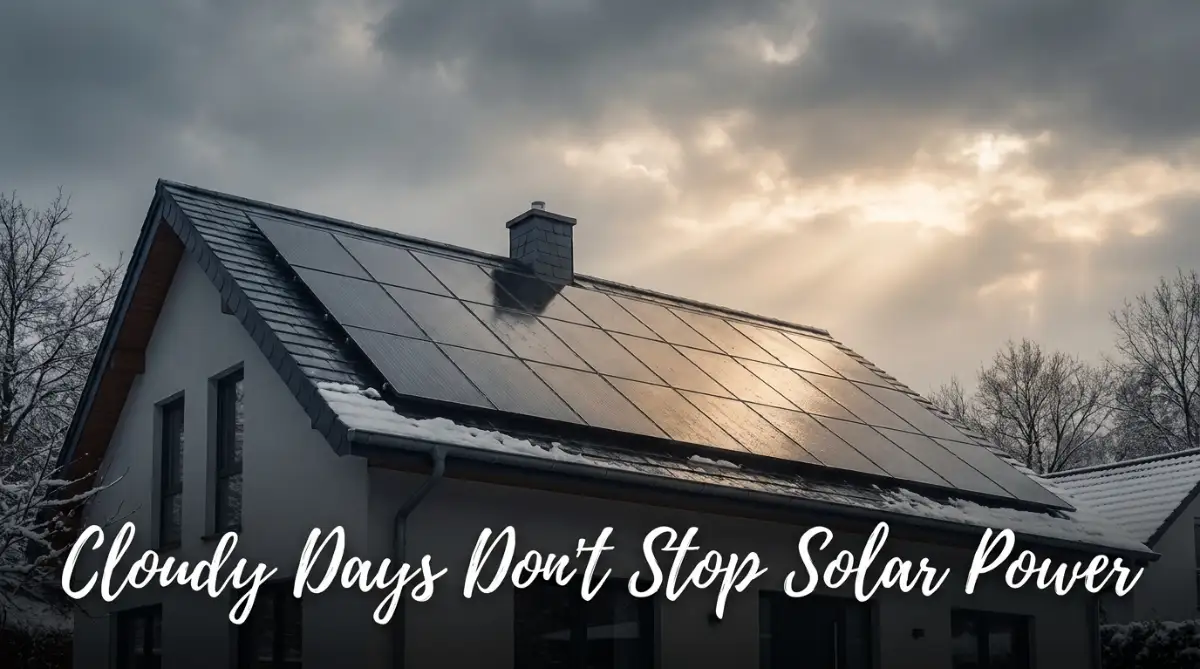
When the clouds roll in, the visible light might drop, making things look dark to human eyes. But your panels do not see the world the way human eyes do. They are designed to capture a much broader spectrum of light.
Even on the gloomiest afternoon, a massive amount of solar radiation is still hitting the earth. Your system is quietly sitting up there, soaking in those invisible rays. It is working hard while you are sitting inside drinking hot coffee.
Do they produce as much power as they do on a perfectly clear day? No, they do not. But they absolutely do not shut down, and they continue to offset your daily household energy usage.
The Surprising Truth About Cold Weather and Electricity
Now, let us talk about the cold weather itself. This is where the science gets really interesting and works entirely in your favor.
Cold temperatures actually improve the conductivity of your solar cells. When materials get hot, the electrons inside them start moving around erratically. This chaotic movement creates resistance, which makes it harder for the electricity to flow smoothly into your home.
Think of it like trying to run through a crowded hallway. If everyone is bumping into each other, you slow down. Heat creates that crowded, bumpy hallway for your electricity. When the temperature drops, that hallway clears out. The electrons can flow in a straight, fast line. This means that a cold solar cell operates much more efficiently than a baking hot one.
How Winter Frost Boosts Performance
Because of this lack of heat resistance, your panels can convert a higher percentage of the light they receive into usable household current. So, even though there might be fewer hours of daylight in the winter, the system makes the most out of every single minute.
Many solar owners notice that on a clear, freezing winter morning, their system hits its highest peak performance of the whole year. The combination of bright light and cold glass is a match made in heaven for energy production.
Pro Tip: If you want to see this in action, check your solar app on a cold morning right after a storm clears. You will likely see a massive spike in energy generation that rivals your best summer days.
Myth vs Reality: The "Thick Cloud" Blackout
A very common myth I hear all the time is that thick clouds create a total blackout for solar production. People believe that if there are no direct shadows on the ground, the system is dead.
Let us break down exactly what happens when light hits a thick cloud. The sunlight does not simply bounce off the top of the clouds and disappear into space. Instead, it enters the cloud and scatters in a million different directions.
This creates something scientists call diffuse light. While direct sunlight beams straight down like a laser pointer, diffuse light glows from everywhere like a soft room lamp.
Capturing the Scattered Rays
Your panels are built with anti-reflective coatings. These coatings are specifically engineered to grab light coming in from strange angles. They are hungry for those scattered, diffuse rays bouncing out of the clouds.
Modern photovoltaic technology is incredibly sensitive. As long as there is enough daylight for you to read a book outside, your system is generating voltage.
It might be producing 20% to 40% of its maximum capacity on a heavy overcast day. But if you have a properly sized system, that percentage is often still enough to power your fridge, lights, and television.
Let's Look at the Data: Summer vs Winter Output
To make this completely clear, I want to show you a simple comparison. Let us look at how the different seasons actually affect your equipment on a technical level.
Looking at this table, you can see the trade-offs. Yes, the thick clouds reduce the total volume of light reaching the roof. But the cold temperature fights back by making the system extremely efficient at processing whatever light it does catch. This balance keeps your home running smoothly. It prevents the massive drop-offs that salespeople from fossil fuel companies try to scare you with.
The Magical Albedo Effect of Winter Snow
What happens when it actually snows? This is another massive point of anxiety. Homeowners assume that once the ground turns white, the game is over.
But snow actually brings a hidden superpower to your energy setup. This is known in the scientific community as the Albedo Effect. Snow acts like a giant, natural mirror spread across your neighborhood.
When the sun finally peaks out from behind those clouds, the light hits the white snow and bounces right back up into the sky. Your panels catch the sunlight coming down from the sky, and they also catch the light reflecting up from the yard.
The Double-Sided Energy Bonus
This reflection can significantly boost your energy generation. The ambient light in your area becomes incredibly intense. Even on days with a thin cloud cover, the snow amplifies the brightness of the whole environment.
Of course, this only works if the panels themselves are clear. But here is another comforting fact: solar panels are installed at an angle. They are also made of dark, smooth glass that absorbs whatever tiny bit of heat is available.
When snow falls on them, it usually slides right off as soon as the sun comes out. The dark surface warms up just enough to melt the bottom layer of snow, sending the rest sliding down into the gutters. You rarely have to climb up there with a broom.
Real-Life Scenarios: Surviving a Week of Gloom
Let us step away from the science for a moment and talk about real life. What actually happens to your daily life if you get five days of ugly, cloudy weather in a row?
If your system is tied to the local power grid through net metering, you have absolutely nothing to worry about. During the bright summer months, your system overproduces energy. You send that extra power back to the grid, building up heavy credits with your utility company.
When that dreary winter week hits, your panels will produce less energy than you use. But instead of getting a massive bill, you simply cash in the credits you banked during the summer.
The Battery Backup Safety Net
What if you live off the grid or have a home battery system? Modern lithium-ion solar batteries are designed specifically for these cloudy stretches. They store energy densely and release it slowly.
Even at 20% production on a heavily clouded day, your panels are constantly trickling power into that battery. They keep the battery from draining completely dry. It acts like a slow, steady drip that keeps your essential appliances alive until the sun breaks through.
This means your morning coffee stays hot, your internet router stays on, and your family stays comfortable. The panic you felt looking out the window is completely replaced by the quiet hum of reliable technology.
Smart Homeowner Strategies for Gloomy Weather
Now that we understand the hidden science behind winter sunlight, we can take things to the next level. You do not have to sit around and passively wait for the weather to clear up. There are proactive steps you can take to make sure your home stays fully powered all winter long.
These are the exact same strategies that industry experts use on their own homes. We are going to look at how to optimize your setup to catch every possible ray of diffuse light.
The first thing you need to check is your inverter technology. Inverters are the brains of your whole operation, turning raw solar power into the electricity your house actually uses.
The Christmas Light Analogy
If you have an older system, you might have something called a string inverter. Imagine a cheap string of holiday lights where one broken bulb causes the entire string to go dark. A string inverter works exactly like that.
If a thick winter cloud casts a dark shadow over just two panels on your roof, the entire system slows down. Your overall power drops to match the weakest link in the chain. This is a massive waste of potential energy during the colder months.
The modern solution to this problem is using micro-inverters. With this setup, every single panel on your roof gets its own independent brain. If half of your roof is covered in deep shade, the other half keeps pumping out maximum power without missing a beat.
Master Your Battery Storage Habits
If you have a home battery system, managing it properly during overcast weeks is essential. Think of your solar battery like a giant sponge that soaks up energy when the sun shines. During heavy winter storms, you need to squeeze that sponge very carefully.
Many homeowners make the mistake of leaving high-drain appliances running when the sky gets dark. You need to adjust your energy consumption habits to match the weather forecast.
Run your heavy appliances, like the electric dryer or dishwasher, during the brightest part of the day. This allows your home to use the solar power immediately, rather than draining your backup battery reserves at night.
Just like you should strictly avoid using unofficial fast chargers for your mobile devices to protect battery health, your solar storage needs careful protection. Running a home battery down to absolute zero repeatedly can permanently damage its lifespan.
The Truth About Roof Snow Removal
Let us address the elephant in the room regarding cold weather maintenance. You look out the window, see two inches of fresh snow on your roof, and immediately feel the urge to grab a ladder.
I strongly advise you to stay off that ladder.
Climbing onto an icy, slanted roof is incredibly dangerous for an untrained homeowner. Beyond the risk of falling, you actually risk severely scratching the anti-reflective coating on your expensive equipment. Using a standard household push broom can leave tiny micro-scratches that permanently block incoming light.
Detailed research from the National Renewable Energy Laboratory on cold-climate solar performance shows that a light dusting of snow has a very minimal impact on yearly production. As soon as the sun comes out, the dark glass absorbs heat and naturally melts the bottom layer of snow. The entire sheet will usually slide right off on its own.
The Hidden Traps That Destroy Winter Energy Production
Even with the best technology installed, human error can quickly ruin your energy savings. When the sky turns gray and the energy app shows low numbers, people start to panic. This panic leads to very bad decisions.
I want to share a few real-life scenarios I see constantly in the renewable energy community. Avoiding these specific mistakes will save you thousands of dollars in ruined equipment and voided warranties.
These errors often happen because homeowners treat their high-tech energy grid like standard home plumbing. Your panels are delicate electronic instruments, not tough roofing shingles.
The Thermal Shock Disaster
This is perhaps the most expensive mistake a homeowner can make in the middle of January. Imagine you have a thick layer of stubborn ice stuck to your panels after a freezing rainstorm. You want your system running again, so you hook up a garden hose to your hot water valve.
You spray warm water directly onto the freezing cold glass. You think you are being clever by melting the ice quickly.
In reality, you have just destroyed your entire system in less than five seconds.
When glass goes from freezing cold to warm instantly, it experiences severe thermal shock. The glass expands too rapidly and shatters into thousands of tiny micro-cracks. This completely voids your manufacturer warranty, leaving you to pay out of pocket for a total replacement.
Obsessing Over the Daily Ticker
Another common pitfall is falling into the trap of daily energy anxiety. Homeowners will open their smartphone monitoring app five times a day during a cloudy week. They watch the power generation dip and start stressing out over the lost pennies.
This behavior is completely unproductive and ruins your peace of mind. Solar energy is a long-term financial game, not a daily contest.
This kind of financial panic is very similar to the extreme anxiety people feel when they suddenly hit unexpected credit score traps before buying a house. You lose sight of the big picture because you are hyper-focused on a temporary dip in the numbers.
The "Phantom Drain" Misunderstanding
Some people take matters into their own hands and completely shut off their inverter during heavy snowstorms. They assume that if the system is not producing heavy power, it must be draining electricity from the grid just to stay awake.
While inverters do have a tiny standby power draw, it is incredibly small. Shutting the system down manually is a terrible idea for several reasons.
First, you might forget to turn it back on when the sun finally breaks through the clouds. Second, your monitoring software loses its connection, messing up your entire yearly data report. The U.S. Department of Energy provides clear guidance on smart energy systems, noting that these units are designed to safely manage their own standby states.
Just leave the system switched on and let the automated technology do its job.
Action Plan for Tomorrow’s Forecast
We have covered a lot of ground today, from the science of scattered light to the dangers of thermal shock. You should now look at a cloudy winter sky with confidence instead of fear.
Your renewable energy setup was mathematically designed to handle these exact weather conditions. The engineers who built your equipment factored in local weather patterns, winter cloud cover, and seasonal shifts. They already did the hard math so you do not have to.
We often ignore the brilliant engineering happening right above our heads. People generally have major blind spots in their standard auto insurance policies, and they have similar blind spots when it comes to understanding renewable energy. Education is the key to maximizing your investment.
Your Quick Winter Checklist
To make this super practical, I want you to take a few specific actions this week. These small steps will ensure you are getting the most out of your system right now.
- Audit Your App: Open your monitoring app and look at your yearly average, not just today's performance. You will likely see that your bright summer days heavily outweigh the winter slump.
- Adjust Your Thermostat: Lower your home heating by just one or two degrees on heavy overcast days. This slightly reduces your total energy load, helping your battery backup last much longer.
- Let Nature Work: Make a firm promise to yourself that you will never climb on your roof with a snow shovel. Let the dark glass and the natural sunlight handle the ice melting process for you.
Technology in the renewable sector is getting smarter every single day. Just as the tech industry is rapidly adapting to the reality of AI replacing software engineers, home energy grids are becoming wildly intelligent. Your panels are constantly communicating with your inverter to optimize every single ray of light.
So, the next time you wake up to a gloomy, gray winter morning, take a deep breath. Pour yourself a hot cup of coffee, turn on the lights, and smile. Your rooftop is quietly collecting invisible energy, saving you money while the rest of the neighborhood pays full price.
Disclaimer: The information provided in this blog post is for educational and informational purposes only and does not constitute professional electrical or financial advice. Always consult with a certified solar technician or your system manufacturer before performing any maintenance on your home solar setup. Individual solar energy production will vary based on geographic location, system size, and local weather patterns.